
AI needs structure – why CPQ makes AI practical in complex sales
- ai
- CPQ
- Summium
AI features are easy to demonstrate, but in complex sales their real value depends on context. When product logic, pricing rules and quote data are structured through CPQ, AI can support everyday work in a more reliable and practical way.
Artificial intelligence is often introduced through visible features: a chatbot, an assistant, an agent, a recommendation or a generated summary. These features are easy to demonstrate, and they can be impressive. But in business-critical environments, the real question is not whether AI can produce an answer. The real question is whether that answer is based on the right context.
This is especially important in complex sales. When products are configurable, pricing depends on rules, and quotes require technical accuracy, AI cannot rely on generic knowledge alone. It needs to understand the product logic, commercial rules, historical data and the process around them. This is where CPQ becomes highly relevant. Configure, Price & Quote solutions help companies manage this complexity by turning product knowledge, configuration rules, pricing logic and quote creation into a guided process. CPQ not only supports quote generation; it brings together product modeling, configuration logic, pricing and the quotation process into one coherent whole. This also makes it possible to use AI in practical and context-aware ways.
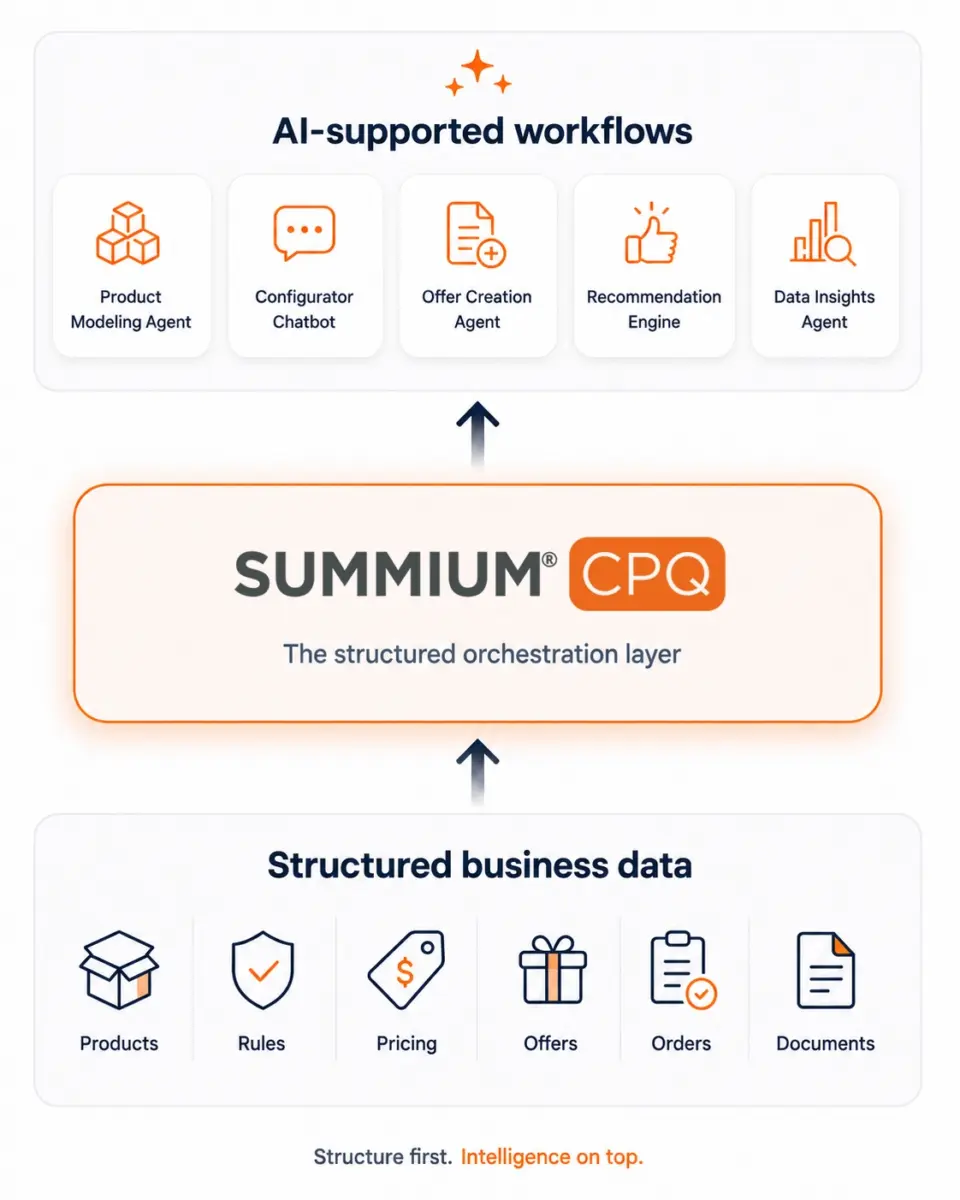
AI is only as useful as its context
Many organizations are currently exploring how AI could support sales, product management and customer-facing processes. The potential is clear: AI can help interpret documentation, support product modeling, answer product-related questions during configuration, guide users in complex choices and reduce manual work throughout the quotation process.
But if the underlying information is scattered across spreadsheets, documents, emails and individual experts, AI can only go so far. This is still the reality in many organizations: critical knowledge lives in scattered files, tacit expertise and manual workarounds. AI may help with generic writing or summarization, but it cannot reliably support decisions that depend on product rules, pricing logic or customer-specific configurations.
In other words, AI needs more than data. It needs structured, meaningful and governed context. That is exactly what CPQ brings to complex sales environments.
CPQ turns complexity into structure
Configure, Price & Quote solutions are designed to manage complexity. They help define how products can be configured, how different options depend on each other, how pricing is calculated and how quotes are generated. Instead of relying on memory, manual checks or scattered documentation, CPQ creates a shared structure for sales and product information. This structure not only improves today’s process; it also makes the same information reusable for analytics, automation and AI-supported work.
For sales teams, this means more reliable quotes and fewer errors. For product teams, it means clearer rules, better maintainability and a lower threshold for developing or updating product structure. Different product variations can be explored with less manual effort, and management gains data that is easier to analyze and use. For AI, this kind of structured environment makes context-aware support possible.
AI does not replace CPQ logic
One common misconception is that AI could simply “take over” configuration or quoting. In reality, this is rarely the right approach.In complex CPQ environments, correctness matters. A product configuration must be valid. Pricing must follow agreed rules. A quote must reflect what can actually be delivered. AI can help users navigate complexity, but it should not replace the business logic that ensures correctness. A useful way to think about the relationship is this:
AI helps users interact with complexity. CPQ ensures that the outcome is correct.
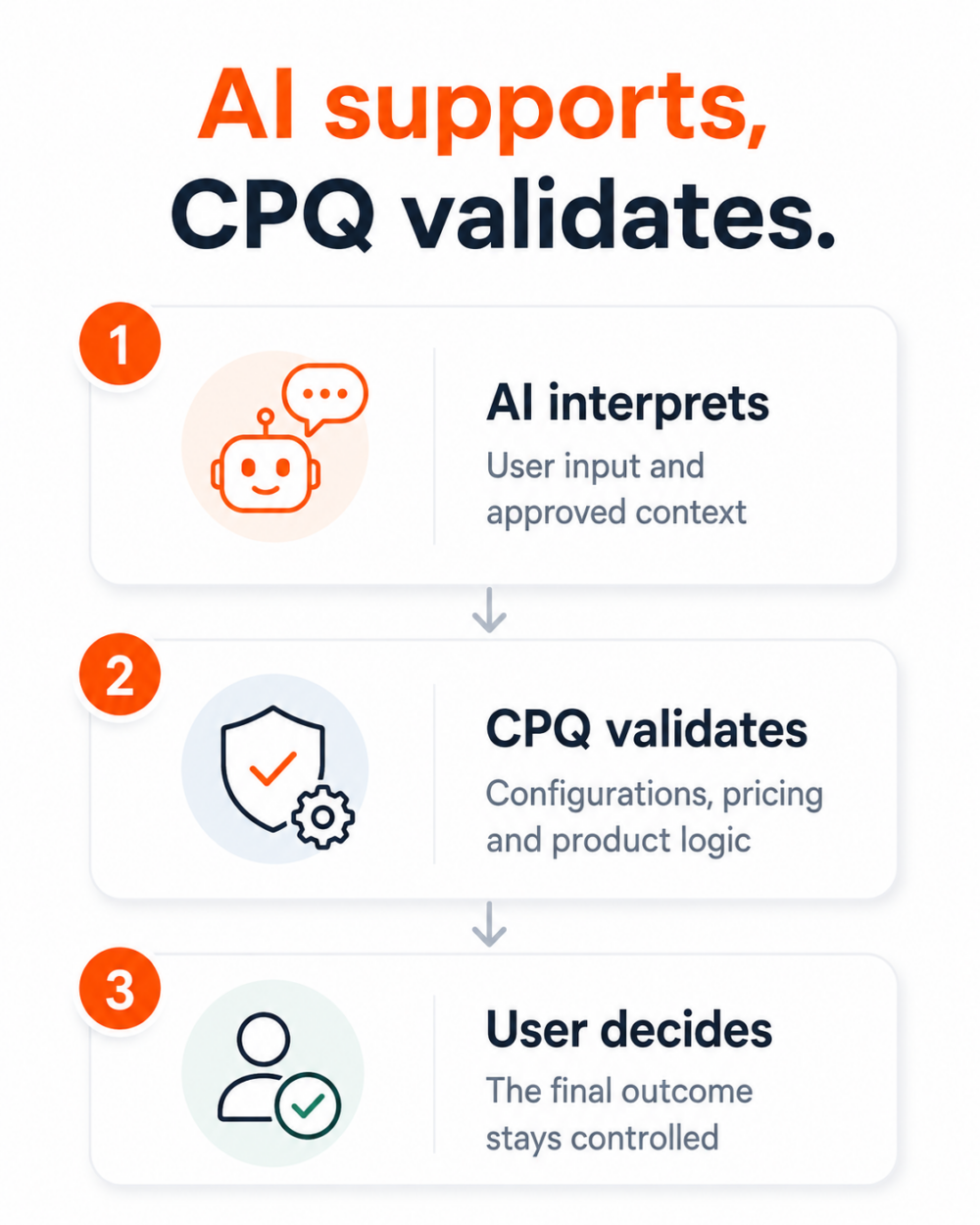
For example, an AI assistant can help a salesperson describe a customer need in natural language. It can ask clarifying questions and guide the process forward. But the CPQ system should still validate the configuration, pricing and rules. This combination is powerful because it keeps both flexibility and control. The same principle applies in product modeling: AI can help interpret source material and suggest possible structures, but the CPQ environment still provides the logic and validation that make the model usable.
AI becomes useful when it supports real work
When AI is connected to a structured CPQ environment, it can support work in many ways: product modeling, quote preparation, recommendations and data analysis. This can shorten the path from documentation to a usable model, reduce manual effort in quotation work and make historical business data easier to use in decision-making.
The important point is that these are not isolated AI features. They become part of the workflow and support everyday work in a more practical way.
Structure makes AI easier to govern
The same structure that makes AI useful also makes it easier to govern. In CPQ environments, data often includes sensitive information: pricing, product structures, customer-specific solutions and commercial logic. This means AI cannot be introduced carelessly. Organizations need to define where AI operates, what data it can access, what it is allowed to do and how responsibilities are managed.
A structured CPQ environment supports this thinking. It makes it easier to define boundaries, permissions and use cases. Instead of giving AI uncontrolled access to business-critical information, capabilities can be exposed in a controlled and purposeful way. This is essential if AI is to become a trusted part of business processes.
Responsible AI also requires a broader perspective than functionality alone. In addition to correctness, governance and business value, organizations increasingly need to consider the environmental, legal and ethical implications of how AI is used. Not every task should be automated with generative AI, and not every use case justifies the cost or impact of large-scale model usage. In complex sales environments, this makes structured and deliberate use even more important: AI should be applied where it brings clear value, under clear control and for clearly defined purposes.
The real question is not “Can we add AI?”
For many organizations, the next step is not simply to ask whether AI can be added to sales or quoting. The more important question is: Do we have the structure that makes AI useful?
If product information, pricing logic and quote data are fragmented, AI will struggle to deliver reliable value. But when these elements are structured through CPQ, AI can support users in more relevant and reliable ways. Many organizations are moving from fragmented product and sales knowledge toward more structured digital processes, and CPQ has already created that foundation.
CPQ brings structure. AI makes that structure actionable.
This article is the first in a series on how AI is changing CPQ. For a deeper look, download our whitepaper AI Powered CPQ: Turning Structured Data into Intelligent Workflows.
Related Products

Author