What is CPQ?
CPQ stands for Configure, Price, Quote, a category of sales software that helps businesses automate the process of building product configurations, calculating accurate pricing, and generating professional quotes. CPQ tools are particularly valuable for companies selling complex or customisable products, where manual quoting would be time-consuming and error-prone. Below, we answer the most common questions about CPQ software and how it transforms modern sales processes.
What is CPQ and what does it stand for?
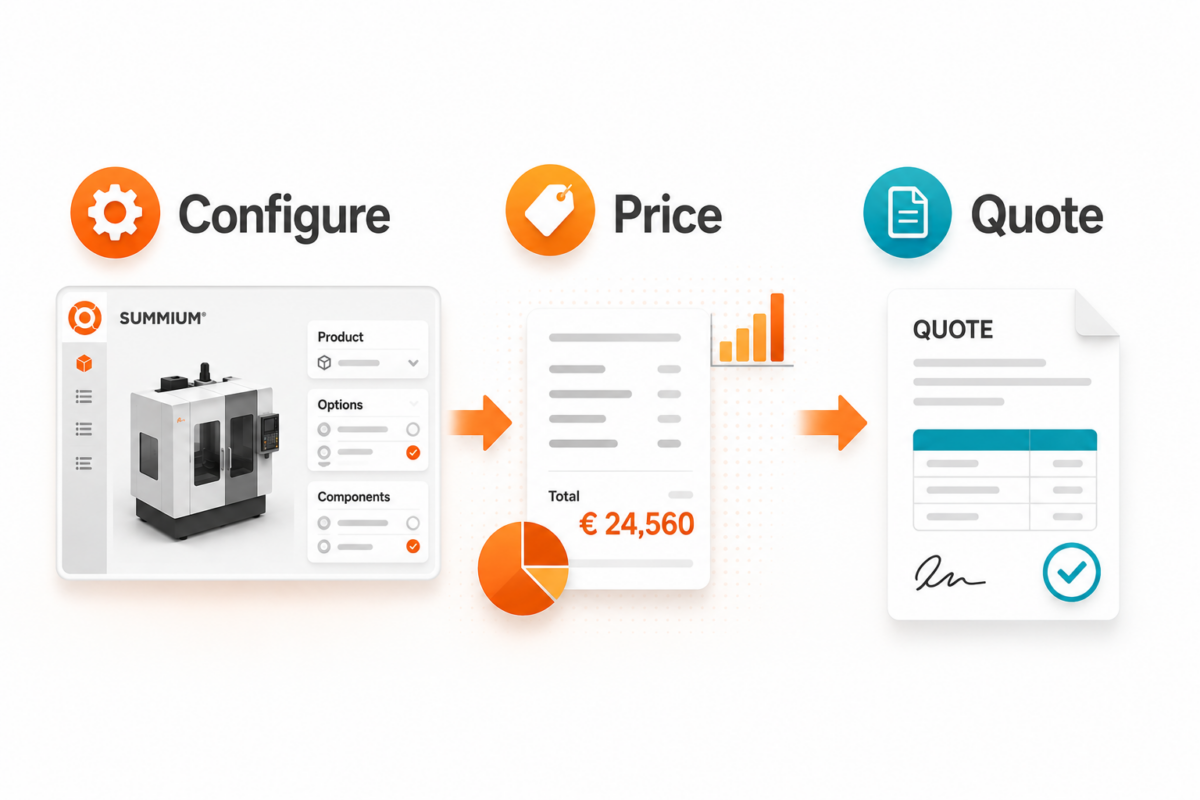
CPQ stands for Configure, Price, Quote. It refers to software that guides sales teams through three essential steps: configuring products to match customer requirements, calculating the correct price based on various rules and conditions, and generating a professional quote document ready for the customer.
This technology exists because many B2B and manufacturing companies sell products with numerous options, features, and customisation possibilities. Without proper tooling, sales representatives must manually piece together product specifications, look up pricing tables, apply discounts, and format quotes by hand. This process is slow, inconsistent, and prone to costly mistakes.
CPQ software brings structure and automation to this workflow. It ensures that every configuration follows valid product rules (so customers cannot order incompatible combinations), that pricing reflects current rates and approved discounts, and that quotes look professional and contain accurate information. The result is a faster, more reliable sales process that benefits both the selling organisation and its customers.
Modern CPQ solutions are typically browser-based, making them accessible from anywhere and easy to integrate with other business systems. They serve as a single source of truth for product knowledge, pricing logic, and quote generation.
How does CPQ software actually work?
CPQ software works through three connected stages that mirror the natural sales workflow. During configuration, users select product options, features, and customisations through a guided interface. The system validates choices in real time, preventing invalid combinations and suggesting compatible alternatives.
The configuration stage is where product complexity is managed. Rather than memorising thousands of possible combinations, sales representatives answer questions or select options from menus. The CPQ system knows which components work together, which require additional parts, and which are mutually exclusive. This guided selling approach means even new team members can configure complex products correctly.
Once configuration is complete, the pricing stage begins automatically. The system applies pricing rules, volume discounts, promotional offers, and customer-specific agreements. It handles calculations that would take considerable time manually, including multi-currency conversions, regional pricing variations, and margin requirements. Approval workflows can trigger automatically when discounts exceed certain thresholds.
The final stage is quoting, where the system generates a professional proposal document. This typically includes product descriptions, pricing breakdowns, terms and conditions, and visual elements like product images or diagrams. The quote can be delivered electronically, often with options for digital signature and acceptance.
These three stages flow together without manual data transfer, reducing errors and accelerating the entire process from initial enquiry to delivered quote.
What types of businesses benefit most from CPQ solutions?
Manufacturers with configurable products gain the greatest value from CPQ software. This includes companies producing industrial equipment, machinery, vehicles, furniture, and any goods where customers choose from multiple options. B2B organisations with complex pricing structures and those selling mass-customised solutions also see significant benefits.
Several characteristics indicate a strong fit for CPQ implementation:
- Products with numerous options, variants, or customisation possibilities
- Pricing that varies based on volume, customer type, region, or configuration
- Sales cycles involving detailed technical specifications
- Quotation processes currently taking hours or days rather than minutes
- Frequent errors in quotes leading to customer dissatisfaction or margin erosion
- Multiple sales channels (direct sales, distributors, online) requiring consistent pricing
Industries where CPQ delivers particular value include manufacturing, industrial equipment, technology hardware, telecommunications, insurance, and professional services with packaged offerings. Any business where the answer to “How much does it cost?” requires asking several clarifying questions is likely a good candidate.
Company size matters less than product and pricing complexity. A smaller manufacturer with highly configurable products may benefit more than a large company selling simple, standardised goods.
What problems does CPQ solve in the sales process?
CPQ addresses several persistent challenges that slow down sales teams and frustrate customers. The most significant is manual quote errors, which occur when sales representatives misconfigure products, apply incorrect pricing, or make calculation mistakes. These errors damage customer trust and can lead to unprofitable deals.
Lengthy quotation cycles represent another major pain point. When creating a quote requires consulting multiple spreadsheets, seeking pricing approvals, and manually formatting documents, customers wait longer than they should. In competitive situations, speed often determines who wins the business.
Inconsistent pricing creates problems both internally and externally. Without centralised pricing rules, different sales representatives may quote different prices for identical configurations. This inconsistency confuses customers and makes revenue forecasting difficult.
Product complexity management becomes increasingly difficult as catalogues grow. Sales teams struggle to remember all valid combinations, leading to quotes for configurations that cannot actually be manufactured or delivered. CPQ systems encode product rules so that only valid configurations reach the quote stage.
Disconnected workflows cause information to be re-entered multiple times, wasting effort and introducing errors. CPQ platforms connect configuration, pricing, and document generation into a single flow, and often integrate with CRM and ERP systems to extend this connectivity further.
Without proper tooling, these challenges compound over time, affecting revenue, customer experience, and operational efficiency.
What should you look for when choosing a CPQ system?
When evaluating CPQ solutions, ease of use should be a primary consideration. The system must be intuitive enough for sales teams to adopt without extensive training. Complex interfaces defeat the purpose of streamlining the quotation process.
Integration capabilities determine how well the CPQ system fits into your existing technology environment. Look for native connections or robust APIs for your CRM platform (such as Salesforce or Microsoft Dynamics) and ERP system. Data should flow smoothly between systems without manual intervention.
Product configuration flexibility matters enormously. The system must handle your specific product structure, whether that involves simple option selection, complex dependencies, or rules-based configuration. Ask vendors to demonstrate configurations similar to your actual products.
Support for complex pricing rules varies significantly between solutions. Ensure the system can accommodate your pricing model, including:
- Tiered and volume-based pricing
- Customer-specific pricing agreements
- Multi-currency support
- Discount approval workflows
- Promotional pricing with date ranges
Deployment options include cloud-based solutions and on-premise installations. Cloud deployments typically offer faster implementation and lower upfront costs, while on-premise installations may suit organisations with specific security requirements.
Consider how the solution handles quote document generation and whether templates can be customised to match your branding. Mobile accessibility is increasingly important for sales teams working remotely or visiting customer sites.
Finally, evaluate the vendor’s industry experience and support capabilities. A CPQ provider with expertise in your sector will understand your challenges and offer relevant guidance during implementation and beyond.
The Next Steps
- Explore our CPQ solution
- Contact our experts