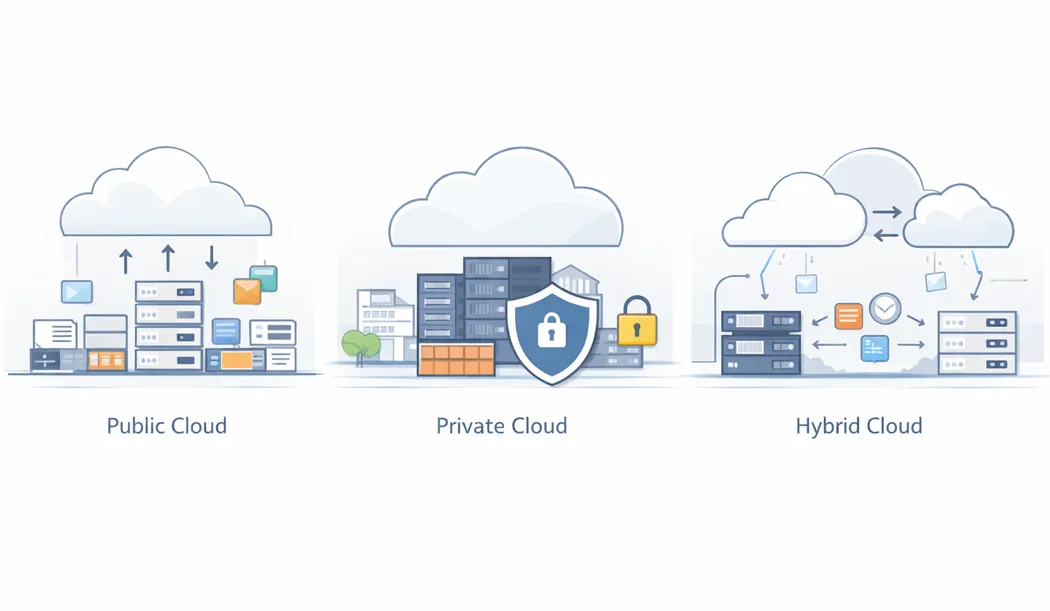
What are the three main types of cloud?
The three main types of cloud are public cloud, private cloud, and hybrid cloud.
Public cloud shares resources across multiple organisations through third-party providers. Private cloud dedicates infrastructure to a single organisation. Hybrid cloud combines both approaches, allowing data and applications to move between environments. Understanding these cloud services helps businesses choose the right deployment model for their specific needs, budget, and security requirements.
What are the three main types of cloud and how do they differ?
The three primary cloud deployment models differ fundamentally in infrastructure ownership, resource sharing, and management responsibilities. Public cloud uses shared infrastructure owned by external providers. Private cloud offers dedicated resources for one organisation. Hybrid cloud blends both, creating flexibility through orchestration between environments.
Each cloud type serves different organisational needs. Public cloud suits businesses that want minimal infrastructure management and maximum scalability. Private cloud appeals to organisations that require complete control over their computing environment. Hybrid cloud works well for companies that need flexibility to balance performance, security, and cost across different workloads.
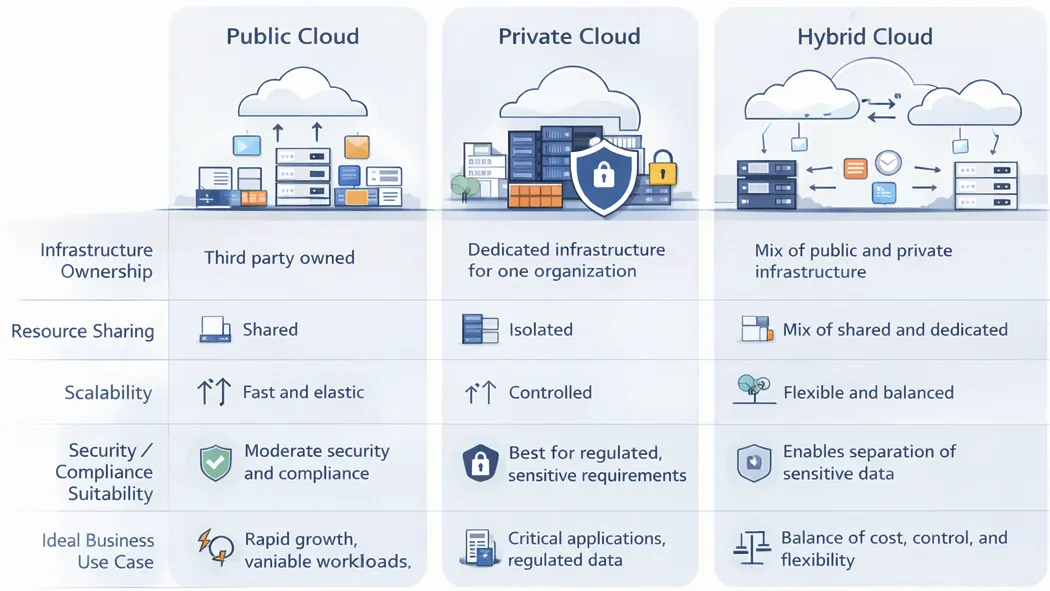
The key distinctions come down to who owns the infrastructure, who manages it, and how resources are allocated. These factors directly influence security posture, compliance capabilities, operational costs, and scalability potential. Choosing between them requires understanding your organisation’s specific priorities and constraints.
What is public cloud and which businesses benefit most from it?
Public cloud is infrastructure owned and operated by third-party providers like Amazon Web Services, Microsoft Azure, or Google Cloud Platform. Resources including servers, storage, and networking are shared across multiple organisations, with each customer accessing their portion through the internet on a pay-as-you-go basis.
The defining characteristics of public cloud services include:
- Scalability that adjusts instantly to demand
- No upfront capital expenditure on hardware
- Pricing based on actual usage
- Maintenance handled entirely by the provider
- Access from anywhere with internet connectivity
Businesses that benefit most from public cloud include startups that need to launch quickly without infrastructure investment, companies with variable workloads that fluctuate seasonally, and organisations experiencing rapid growth that require elastic scaling. Development teams also favour public cloud for testing environments where resources need to be spun up and down frequently.
How does private cloud work and when should you consider it?
Private cloud dedicates computing resources exclusively to a single organisation. The infrastructure can be physically located on-premises within your own data centre or hosted by a third-party provider, but in either case, the resources remain isolated for your organisation’s sole use.
Private cloud environments offer greater control over hardware, software, and security configurations. Your IT team can customise the infrastructure to meet specific performance requirements and implement security measures tailored to your needs. This isolation also simplifies compliance with regulations that restrict where data can be stored and who can access it.
Consider private cloud when your organisation handles sensitive data subject to strict regulatory requirements, such as healthcare records or financial information. Industries like banking, government, and healthcare often choose private cloud to maintain compliance. Organisations that require predictable performance for critical applications also benefit from dedicated resources that eliminate the “noisy neighbour” effect common in shared environments.
What is hybrid cloud and why is it becoming so popular?
Hybrid cloud combines public and private cloud environments with orchestration technology that enables data and applications to move between them. This architecture lets organisations place workloads in the most appropriate environment based on requirements for security, performance, compliance, and cost.
The popularity of hybrid cloud stems from its flexibility. Sensitive data can remain in private infrastructure while less critical workloads run on cost-effective public cloud resources. During demand spikes, organisations can “burst” into public cloud capacity without maintaining excess private infrastructure year-round.
Hybrid cloud services offer several strategic advantages:
- Cost optimisation through workload placement
- Flexibility to adapt as business needs change
- Gradual cloud migration without disrupting operations
- Compliance maintenance while still accessing public cloud benefits
- Business continuity through distributed infrastructure
Many organisations find hybrid cloud provides the best balance between control and convenience, making it increasingly the default choice for enterprise cloud strategy.
How do you choose the right cloud type for your business needs?
Choosing the right cloud deployment model requires evaluating your organisation’s security requirements, compliance obligations, budget constraints, scalability needs, and internal technical expertise. No single cloud type suits every situation, and the best choice depends on your specific circumstances.
Start by assessing your current infrastructure and identifying which workloads could move to cloud environments. Consider the sensitivity of your data and any regulatory requirements governing its storage and processing. Evaluate your budget for both initial migration and ongoing operational costs.
Key questions to guide your decision include:
- What compliance requirements must your infrastructure meet?
- How sensitive is the data you handle?
- How predictable or variable are your computing needs?
- What technical expertise exists within your team?
- What is your budget for infrastructure investment?
Many organisations benefit from working with experienced technology partners who can assess requirements objectively and recommend appropriate solutions. A thorough analysis of current needs and future growth plans helps avoid costly mistakes in cloud strategy.
What role do cloud services play in digital transformation?
Cloud services form the foundation of most digital transformation initiatives by providing the flexible, scalable infrastructure needed for modern business operations. Cloud computing enables organisations to innovate faster, respond to market changes quickly, and deliver better customer experiences without massive upfront technology investments.
The connection between cloud adoption and competitive advantage continues to strengthen. Organisations using cloud infrastructure can deploy new applications rapidly, scale services to meet demand, and access advanced capabilities like artificial intelligence and machine learning without building expertise from scratch.
Successful cloud strategy requires more than choosing between public, private, or hybrid models. It demands understanding how cloud services integrate with existing systems, how data flows between environments, and how to maintain security across distributed infrastructure. This complexity is why many organisations partner with experienced technology specialists who understand both the technical requirements and business implications of cloud decisions.
To explore how tailored cloud solutions can support your organisation’s digital transformation goals, we invite you to learn more about Wapice’s cloud services and discover how our expertise can help you build the right cloud strategy for your needs.