
When machinery goes offline – Data Mule brings operational data into the IoT
- DataMule
- IoT
- iot-ticket
Data Mule enables operational data to be collected from machinery even when a continuous network connection is unavailable. An operator’s smartphone can act as a link between the machine and an IoT platform. The key consideration is not whether data is transferred in real time, but how quickly it is actually needed.
Real-time data is a frequent topic in industrial digitalization. However, a continuous connection is not necessary in every use case, nor is it always possible. Forestry and agricultural machinery, underground mining equipment, and machines operating at remote construction and infrastructure sites, for example, may spend extended periods beyond mobile network coverage. Yet their operating hours, consumption figures, and production volumes provide valuable information for maintenance, fleet management, and operational planning.
Data Mule offers a practical data transfer solution for these environments, making operational data available without requiring every machine to have a continuous network connection.
Data Mule transfers data when a connection becomes available
Data Mule works by storing data temporarily and transmitting it later. Instead of equipping every machine with its own network connection, the solution uses a device that is already brought close to the machine as part of normal operations. Typically, that device is the operator’s smartphone.
The machine records its operational data, for example, in files for each work shift. When the phone is nearby, an app retrieves the files over a short-range wireless connection such as Bluetooth Low Energy (BLE). The phone stores the data and uploads it to the IoT platform once a network connection is available again. The delay may range from a few minutes to a full day, but the machine itself does not need an internet connection. The underlying idea is simple: rather than bringing connectivity to the machine, you can bring the data to a connection.
Not all operational data needs a real-time connection
When choosing a connectivity solution, the most important question is how quickly the data needs to be acted upon. Alarms, remote control, and diagnostics requiring an immediate response need a continuous or sufficiently up-to-date connection. By contrast, tracking operating hours, reporting fuel and energy consumption, analyzing production volumes, and reviewing load cycles do not necessarily require data to be available within seconds or minutes.
If data delivered once per shift or once a day is sufficient for maintenance planning or reporting, Data Mule can reduce the need for machine-specific connectivity hardware and data subscriptions. It can also bring previously unmonitored equipment into the scope of data collection.
Other connectivity options are available. A cellular modem is suitable for machines operating within mobile network coverage. Satellite connectivity can provide access in remote areas, but the hardware and data transmission may increase costs. Manual data collection using a USB drive or a maintenance laptop, meanwhile, requires additional steps and can delay data availability. Data Mule sits between these alternatives: it makes use of an existing phone and routine visits to the machine. Different solutions can also be combined. For example, a machine equipped with a cellular gateway can use Data Mule as a backup connection when operating outside network coverage.
An effective solution must not add to the operator’s workload
The success of Data Mule depends above all on how well it respects the operator’s time and safeguards the data. Data collection must fit naturally into the operator’s working day. If transferring data involves multiple logins, navigating menus, or long waiting times, collection may become inconsistent. The user experience must therefore be straightforward, with file uploads taking place as automatically as possible in the background.
Data reliability is equally important. A wireless connection may drop during a transfer, so it must be possible to verify file integrity, for example using checksums, and resume interrupted transfers. Data should not be deleted from the machine or phone until the receiving system has confirmed receipt. This helps prevent missing or duplicate records that could compromise reporting.
Security and maintainability are also essential. In addition to device pairing and an encrypted short-range connection, the solution needs secure transmission to the cloud, securely stored credentials, and a controlled software supply chain. Digitally signed software releases, a software bill of materials (SBOM), and regular vulnerability scans make it possible to verify and audit security. A documented machine interface also makes it easier to connect new machine models without having to build every integration from scratch.
Data Mule connects offline machinery to IoT-TICKET
Wapice has developed a Data Mule Android app that retrieves files from machinery over Bluetooth Low Energy and uploads them to the IoT-TICKET platform when network connectivity returns. The protocol between the machine and the app is documented, and an integration guide and machine simulator support implementation. Data is transferred using the same JSON format as other HTTP integrations with IoT-TICKET.
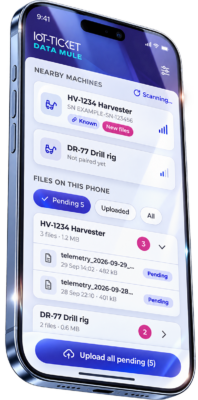
In practice, the greatest benefit is that data arriving through Data Mule does not end up in a separate data repository. Instead, it is transferred directly to the IoT-TICKET platform, where new devices can also be created automatically. The collected data can be viewed in the same IoT-TICKET dashboards, reports, and analyses as data from continuously connected equipment. This provides a more unified view of the entire fleet, regardless of how each machine transmits its data.
Data Mule does not rule out other connectivity methods. Machines can also be connected to IoT-TICKET using pre-integrated devices, Wapice Intelligent Edge software, or an interface provided by an existing telematics unit or control system.
The right data transfer method depends on the use case
Data Mule is particularly well suited to situations where machines are visited regularly and the collected data is used for maintenance, fleet management, and operational planning. If a machine is rarely visited or the data calls for immediate action, a different connectivity solution is needed.
A good starting point is to define which decisions the collected data should support and how quickly the information must be available. You can then assess which machines need their own continuous connection and which can rely on smartphone-based data transfer. This extends the benefits of digitalization to hard-to-reach machinery without unnecessary technical complexity.
When data collection is designed around the use case rather than connectivity technology alone, machinery operating beyond network coverage can also become part of a unified, valuable IoT ecosystem.
Learn more about Data Mule on the IoT-TICKET website: https://iot-ticket.com/iot-ticket-datamule/
Related Products

Author
